



Handcrafted Jewelry vs Machine Made: Quality Guide
Table of Contents
- Handcrafted Jewelry vs Machine Made Quality: The Core Differences
- What Handcrafted Actually Means
- How Machine Made Jewelry Is Produced
- Side-by-Side Comparison: Cost, Durability, and Consistency
- Signs of High-Quality Jewelry Craftsmanship
- Durability of Handmade Jewelry: What the Metal Actually Tells You
- The Hybrid Production Model: When Hand and Machine Meet
- How to Care for 14k Gold Fill (and Other Artisan Metals)
- Investment Value, Ethical Sourcing, and What Lasts
- Frequently Asked Questions
Last Updated: September 28, 2026
Handcrafted Jewelry vs Machine Made Quality: The Core Differences
Handcrafted jewelry is made by a person shaping, wrapping, and finishing each piece by hand, while machine made jewelry is produced through automated casting, stamping, or die-struck processes that repeat a single design thousands of times. The quality gap shows up in three places: how the metal is worked, how the piece holds up over years of wear, and how much control a buyer has over the final result. This guide from Gilded Girl Accessories breaks down where handcrafted jewelry wins, where machine production excels, and how to tell the difference before you spend money.

The stakes are higher than most shoppers assume: a piece that looks identical on a screen can behave very differently after two years of daily wear. Below are the 5 checks that separate real artisan craftsmanship from a marketing claim.
What Handcrafted Actually Means
Handcrafted means a human being shapes, assembles, and finishes the piece, usually with hand tools and wire-wrapping or hand-sculpting methods rather than a production line. The maker controls the tension of every wrap, the placement of every bead, and the final polish.
That control matters more than most buyers realize. A bench jeweler hand-finishing a piece can inspect each connection as it's made and correct weak points immediately; automated production repeats whatever the mold or die produces, good or bad.
A common mistake is assuming "handmade" means rustic or uneven. In practice, skilled hand work allows for tighter tolerances in small batches than mass manufacturing achieves at volume.
How Machine Made Jewelry Is Produced
Machine made jewelry is produced through casting techniques, die-struck stamping, or CAD design paired with automated milling, then finished in bulk. The process is fast, consistent, and inexpensive per unit.
A die-struck piece is stamped from sheet metal under high pressure, which makes the metal denser and stronger at the point of impact. Casting pours molten metal into a mold, which is cheaper but can leave microscopic porosity that weakens the piece over time.
Neither method is automatically bad. The problem is what happens after: mass-produced pieces are often tumbled and polished in bulk, which rounds off fine detail and can thin delicate edges. Quality control is statistical rather than individual.
- Die-struck: Denser metal, sharper detail, best for flat designs
- Casting: Cheaper, allows complex shapes, risk of internal porosity
- CAD plus milling: Highly precise, but detail is only as good as the file
- Bulk finishing: Fast, but erodes fine edges and hand-set detail
Side-by-Side Comparison: Cost, Durability, and Consistency
Handcrafted jewelry costs more per piece because a person spends hours on it; machine made jewelry costs less because the machine doesn't. But the number that actually decides value is cost per year of wear.
A bench jeweler working on a hand-wrapped beaded piece might spend two to six hours on a single item. At a modest bench rate, that labor alone can exceed the entire retail price of a mass-produced equivalent, while machine production spreads its cost across thousands of units so the per-piece labor cost rounds to cents. That is the whole story behind the price difference, and it is not a markup trick.
| Factor | Handcrafted | Machine Made |
|---|---|---|
| Typical cost | Higher per piece | Lower per piece |
| Cost driver | Bench hours plus hand-selected materials | Mold or die amortized over thousands of units |
| Durability | Strong, hand-inspected joins | Varies sharply by method |
| Consistency | Slight variation between pieces | Near-identical units |
| Repairability | Easier, maker knows the build | Harder, often replaced |
| Customization | Full bespoke service | Limited to catalog options |
| Production speed | Weeks | Days |
| Aesthetic uniqueness | One of a kind or limited run | Widely duplicated |
| Resale and heirloom potential | Higher for signed limited runs | Low, design is not scarce |
Now the part most guides skip: cost per year of wear.
When comparing two pieces at different prices, ask the maker how many hours went into the piece and how many units were produced. Those two answers explain almost the entire price gap and tell you whether you are paying for labor or for a brand name.
Signs of High-Quality Jewelry Craftsmanship
High-quality jewelry craftsmanship shows up in details you can inspect in ten seconds: even wire tension, clean joins without excess solder or glue, symmetrical bead placement, and a smooth finish with no sharp edges catching on fabric.
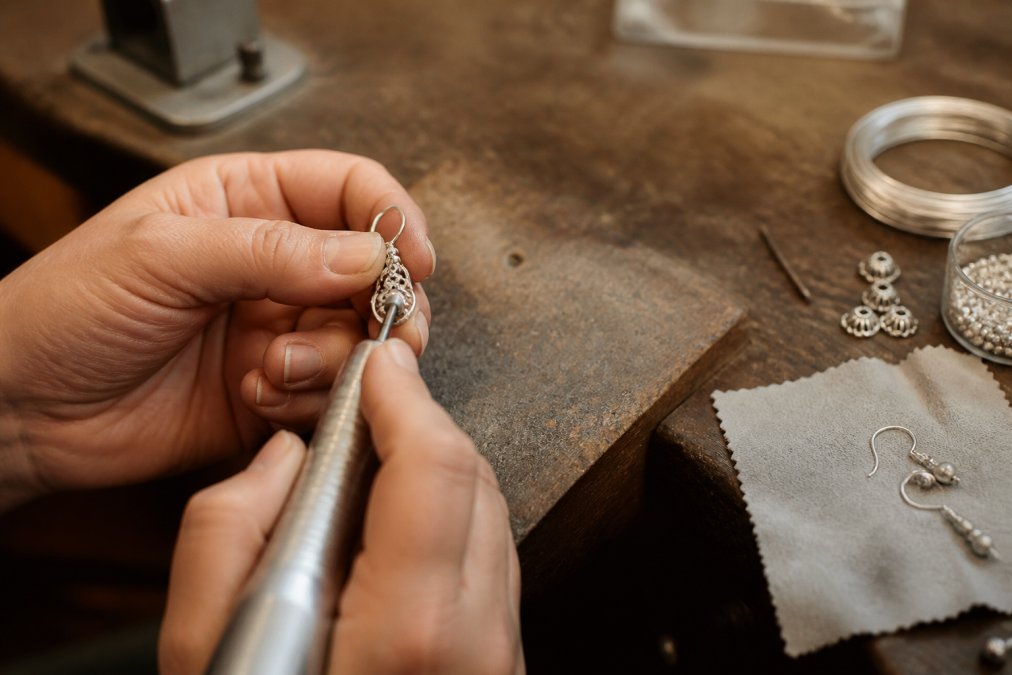
Look for these specific markers:
- Consistent wire wraps: no gaps, no overlapping coils, even spacing
- Clean connections: no visible glue, no lumpy solder joints
- Symmetry: earrings should mirror each other in weight and shape
- Weight: a substantial feel usually signals solid metal, not hollow construction
- Hallmarking: precious metals should carry a stamp indicating metal content
- Finish: edges should be smooth enough to run across your lip without catching
Durability of Handmade Jewelry: What the Metal Actually Tells You
The durability of handmade jewelry depends less on the "handmade" label and more on how the metal was formed. This technical layer is what actually predicts whether a piece survives five years of daily wear.
- Sterling silver: soft, takes detail beautifully, tarnishes without care
- 14k gold fill: thick gold layer bonded to a base metal, wears well for years
- Stainless steel: hardest of the three, resists tarnish, less detailed
- Reclaimed textiles and beading: durable for everyday wear with basic care
The Hybrid Production Model: When Hand and Machine Meet
The hybrid production model combines machine precision with hand finishing, and it's now the most common approach in mid-market jewelry. A piece might be laser-cut or cast by machine, then hand-polished, hand-set, and hand-assembled by a person.

How to Care for 14k Gold Fill (and Other Artisan Metals)
To care for 14k gold fill, polish the piece with a soft jewelry cloth after each wear and store it in a dry fabric bag away from other metals. Gold fill has a thick bonded layer of real gold, so it resists fading far better than plating, but still dislikes abrasion and harsh chemicals.
A simple routine keeps artisan metals looking new:
- Wipe with a jewelry care cloth after wearing to remove oils
- Store in the included fabric bag, not loose in a drawer
- Remove before swimming, showering, or applying perfume
- Keep away from household cleaners and chlorine
- Check wire wraps and bead connections every few months
- Bring loose stones or fraying textile elements to a jeweler early
Investment Value, Ethical Sourcing, and What Lasts
Investment value in jewelry comes from three things: metal content, construction quality, and scarcity of the design. A handcrafted piece from a limited run of 20 to 100 holds its story and rarity; a mass-produced design available in every size does not.
Frequently Asked Questions
How can you tell if jewelry is handmade or machine-made?
Look for small variations between pieces: slight asymmetries, hand-set stones, and visible tool marks are hallmarks of artisan craftsmanship. Machine-made pieces are identical to the millimeter. Check for hallmarks or stamps indicating metal purity, and ask whether the brand discloses its manufacturing process. Limited edition runs of 20-100 pieces, like those from small studios, are a strong signal of handcrafted work rather than mass manufacturing.
Is handcrafted jewelry more durable than mass-produced pieces?
Durability depends more on metal quality and construction method than on whether a piece is handmade. Hand-forged pieces often have fewer weak solder joints because they are shaped from solid wire. However, machine-made pieces can also last decades when made from solid precious metals. The real durability advantage of handmade jewelry is repairability: a bench jeweler can rewrap, re-solder, or reshape a handcrafted piece rather than replacing it entirely.
What are the benefits of choosing 14k gold fill over plated jewelry?
Gold fill contains a thick layer of 14k gold bonded to a base metal core, usually brass. That layer is measured in microns and is legally required to be at least 5% of the total weight. Gold plating is typically just 0.5 to 2.5 microns thick and wears off within months of daily wear. Gold fill resists tarnishing and flaking for years, making it a practical choice for earrings and cuffs worn regularly.
Does machine-made jewelry have better consistency than artisanal pieces?
Yes, machine manufacturing produces near-identical pieces with tight tolerances, which matters for clasps, hinges, and sizing. Artisan pieces vary slightly because each one is shaped by hand. That variation is intentional in limited edition designs, where no two pieces are exactly alike. If you need a matched set or a precise fit, machine-made consistency helps. If you want a piece that exists only once, that variation is the point.
How does the manufacturing process affect the longevity of jewelry?
Die-struck and cast pieces rely on molds, which can introduce porosity and weak points at stress areas. Hand-forged and wire-wrapped pieces distribute stress more evenly because the metal is worked rather than poured. Proper jewelry maintenance, including polishing with a care cloth and storing pieces in a fabric bag, extends longevity regardless of how a piece was made. The biggest factor is metal thickness, not production method alone.